Our Breeds
Cane Corso

Country of Origin: The Cane Corso Italiano (also known as the ‘Italian Mastiff’ or ‘Cane Corso Mastiff’) is a war and hunting dog which originated in southern Italy. It likely descends from the Neapolitan mastiff and the Roman ‘Canis Pugnax’, a powerful war dog, though the Cane Corso Italiano is a lighter, more agile breed which was used by troops for hunting or as an auxiliary force (‘Corso’ comes from the Latin for ‘guardian’). The Cane Corso Italiano was also used in bull baiting, a gambling ‘sport’ wherein one or more dogs were matched up against a chained bull. The Cane Corso Italiano had declined to near extinction by the 1980’s, but since then an intentional effort to rescue the breed has increased the dog’s numbers substantially. It is most prominent in southern Italy.
Size: The Cane Corso Italiano has a shoulder height of 64-69 cm (24-27 in) for males and 58-61 cm (23-25 in) for females. Males weigh 45-50 kg (99-110 lbs) and females 40-45 kg (88-99 lbs). The Cane Corso Italiano is large, lean, and athletic in appearance, with ‘V’-shaped ears that flop forward, a long wide, muzzle, pronounced stop, and arched neck.
Coat: The Cane Corso Italiano has short, dense, stiff hair in black, gray, fawn, or striped. It may have a black or grey muzzle or white markings on the chest and feet. The Cane Corso Italiano is a light shedder.
Character: The Cane Corso Italiano is a highly intelligent, loyal and protective dog that is very versatile and trainable. It is even tempered, alert, and confident, making an excellent guard or watchdog. Cane Corso Mastiffs are not aggressive, but will defend their owners fiercely when necessary. They are nearly unstoppable in a fight due to their unusually high pain tolerance.
Temperament: The Cane Corso Mastiff is loyal, docile, and affectionate toward its family, especially children. The Cane Corso Italiano should be socialized when young to minimize aggression with strangers and other dogs, but even with training Cane Corso Italianos are usually on edge around those they don’t know.
Care: The Cane Corso Italiano does not require much grooming—only an occasional brushing to remove dead hairs is required. Cane Corso Mastiffs don’t mind living outdoors as long as sufficient socialization and shelter is provided. Like other large breeds, the Cane Corso Italiano is susceptible to hip dysplasia. It is also prone to bloat, so avoid overfeeding and space meals throughout the day. The Cane Corso Mastiff has a life span of 10-11 years.
Training: The Cane Corso Italiano is intelligent and easily trainable. It is versatile and can quickly learn a wide variety of tasks. Cane Corso Italianos are a fairly large animal with a mind of their own, so inexperienced owners should think twice about selecting this breed. The Cane Corso Italiano must be taught to submit to all family members. Obedience training is highly recommended for the Cane Corso Mastiff.
Activity: The Cane Corso Italiano is athletic, requiring a substantial amount of daily exercise. It has high stamina, making it a great companion for long jogs or hikes. A fenced in yard is recommended; an apartment may not provide sufficient space.
Chinese Crested
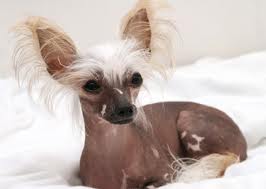
Country of Origin: The Chinese Crested is a small breed known for its distinct appearance and personality. There are ‘Hairless’ and ‘PowderPuff’ varieties which are so different in appearance that they are sometimes mistaken for different breeds, but in fact hairlessness is a genetic trait; both types can be born in the same litter! There are many theories as to the Chinese Crested’s ancestry. Some say it a cross between Chinese breeds and an African breed which introduced the hairless gene and others say it is a cross between the Chihuahua and Mexican Hairless Dog. Some even think that Chinese Cresteds (along with the Rhodesian Ridgeback and a few other breeds) are a distinct species from all other dogs! In any case, the Chinese Crested was brought to China in the thirteenth century where it became a popular rat hunter and trading curiosity among sailors. It spread on sailing vessels throughout the mid-East, Africa, and South America. The Chinese Crested was not recognized by the American Kennel Club until 1991. Today, it is a popular show dog with a modest but devoted fan base among pet owners. Chinese Cresteds are sure to catch on in popularity in the coming years. A Chinese Crested named ‘Sam’ was the three time winner of the World’s Ugliest Dog competition, but don’t let that spoil the whole breed for you—Sam just happened to be quite ugly!
Size: The Chinese Crested has a shoulder height of 23-33 cm (9-13 in) and weighs up to 6 kg (13 lbs). It has a broad head, long muzzle, very large, upright ears, and almond shaped eyes. Chinese Cresteds have a flat back, merrily carried tail, and distinctive long, narrow ‘hare feet’.
Coat: There are two distinct varieties of Chinese Crested—the ‘Hairless’ Chinese Crested and the more common ‘Powder Puff’ Chinese Crested. The Hairless Chinese Crested (slight misnomer) has soft, humanlike skin and tufts of fur on its head and ears (the ‘crest’), tail tip (‘plume’), and feet (‘socks’). It may have small tufts of fur elsewhere. The Hairless Chinese Crested ranges from pale to black. The Powder Puff Chinese Crested has a thick double coat with a very soft, silky topcoat. It may be groomed with a full face of hair, in which case it has the appearance of a Terrier, but more commonly the snout is shaved. All Hairless Chinese Cresteds carry the Powder Puff gene as a recessive trait, as the mix of two Hairless genes is fatal in unborn puppies. This means that two Hairless Chinese Cresteds may give birth to a PowderPuff Chinese Crested. Both types of Chinese Crested are good fur allergy sufferers (pun intended).
Character: Chinese Cresteds have a distinctive extroverted personality. They are playful, sensitive, and high-spirited, but cautious of people they do not know. A few Chinese Cresteds are ‘one person’ dogs which grow particularly attached to one person, but most will grow attached to the whole family. Chinese Cresteds are highly entertaining and cuddly.
Temperament: The Chinese Crested gets along well with children (provided they respect its personal space), other dogs, and any household pets. Young children should be watched around the Hairless Chinese Crested as it does not have the coat most breeds have to protect it from rough play.
Care: The Powder Puff Chinese Crested must be groomed daily and washed frequently to prevent matting. The muzzle must be shaved every few weeks (or allowed to grow out). The Hairless Chinese Crested’s skin should be cared for with lotion and exfoliating creams. It should be kept out of the sun or protected by sunscreen. Chinese Cresteds are not suited to outdoor life or cold climates; the Hairless Chinese Crested should be given a sweater for walks in cold weather. Hairless Chinese Cresteds may not have a full set of teeth, but this is not considered a health risk or a fault for show dogs. Most need to be shaved, but carefully so as to avoid irritating the skin. Avoid overfeeding as it may result in obesity.
Training: The Chinese Crested's intelligence makes it easy to train, but it is sensitive and requires a gentle approach. The Chinese Crested can learn a wide variety of tricks.
Activity: The exercise needs of the Chinese Crested are uncomplicated. It prefers a daily walk, but can usually have its needs met by indoor play. The Chinese Crested is well suited to apartment life.
American Bulldog
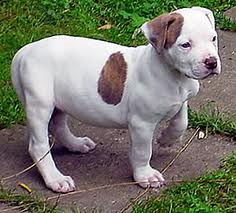
Country of Origin: The American Bulldog is a descendant of the English Bulldog, imported to the American South to catch livestock and protect plantations, and used in the North to fight off feral pigs. The English Bulldog (or simply ‘Bulldog’) was bred in England in the 1500’s for bull baiting, a popular gambling ‘sport’ in which one or more dogs were matched up against a chained bull (or bear). These dogs were bred for sheer fighting capacity, and they were famed for latching onto their prey with an iron jaw which they refused to release—they could even suffocate opponents this way. The American Bulldog is perhaps the most faithful strain to the English Bulldog as it was imported to America before the English Bulldog was crossed with the Pug during the Industrial Revolution. American Bulldogs are generally divided into two strains: the Classic American Bulldog, also known as the ‘Johnson’ (after its breeder) or ‘Bully’, and the Standard American Bulldog, also known as the Scott (after its breeder) or ‘Performance’.
Size: The American Bulldog is a bit faster and substantially larger than the French or English Bulldog at 50-71 cm (20 to 28 in) and 27-54 kg (60-120 lbs). The Johnson American Bulldog is the larger of the two strains. The American Bulldog’s face resembles a Pit Bull, but the muzzle is boxier and it typically has uncropped ears and a bulkier head. The American Bulldog is built strong and agile, with a large chest and legs, low-set tail, and stocky frame.
Coat: The American Bulldog has a short coat which is close and stiff to the touch. Most American Bulldogs are white with patches, but any color combination is acceptable except solid black or blue, or white with black and tan.
Character: The American Bulldog is powerful, confident, and agile. It is naturally alert, inquisitive and fearless. It has often been called heroic, and when deployed against an intruder it is nearly unstoppable. The American Bulldog is a highly obedient and confident breed.
Temperament: The American Bulldog is affectionate toward children if properly trained and socialized. It can be somewhat standoffish or aggressive around strangers. Because they were originally bred to bring down bulls and other livestock, American Bulldogs have a strong aggressive instinct with other animals. They should be properly socialized when young.
Care: When the American Bulldog is shedding, use a coarse comb to remove dead hairs. It is prone to hip dysplasia. The American Bulldog has a lifespan of 8-12 years. Most American Bulldogs cannot swim and are averse to hot weather.
Training: Consistency is important, but the American Bulldog is highly sensitive to the tone of its handler's voice, making training a fairly simple process. It is inquisitive and quick to learn simple tasks, yet unpredictable as it is a bit stubborn on occasion. Training should begin as early in the American Bulldog's life as possible. It retains what it learns for a very long time.
Activity: The American Bulldog is very energetic and needs lots of exercise. American Bulldogs enjoy long walks, jogging, playing catch, and agility or skills trials.
Pekingese
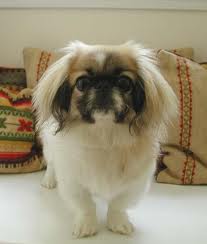
Country of Origin: The Pekingese (also known as the ‘Lion Dog’, ‘Foo Dog’, ‘Fu Dog’, ‘Peking Palasthund’, and of course ‘宮廷獅子狗’) is an ancient breed from China of unknown ancestry, though by Buddhist legend it was created from the mating of a lion with a butterfly, monkey, or marmoset. ‘Peking’ is an old transliteration of Beijing, the capital city of China. The Pekingese has changed little in over 2000 years. It was bred by Lamaist Buddhist monks who believed lions embodied the essence of Buddha and sought to create a lion-like dog. Pekingese became companions for royalty, permitted to breed only in the Imperial Palace. During the T’ang Dynasty (700-1000 A.D.) Pekingese were even considered to be royalty themselves, with personal servants at their disposal. Pekingese came to the west in 1860 when the British raided the Forbidden City and seized five Pekingese belonging to the Emperor’s Aunt, which were sent as a gift to Queen Victoria and other British royalty. They were highly popular back in England, gradually increasing in number and growing in popularity through modern day. In the early 20th century, the Chinese Empress Dowager Cixi presented a small black Pekingese named ‘Manchu’ to President Theodore Roosevelt’s daughter Alice. Other famous Pekingese include romance novelist Barbara Cartland’s white dog ‘Peke’ and ‘Sun Yat Sen’, pet of Henry Harper from Harper Brothers Publishing, who, along with his owner, survived the Titanic disaster!
Size: The Pekingese has a shoulder height of 15-23 cm (6-9 in) and weighs 3-6 kg (7-14 lbs). It has a very large, flat skull, flat muzzle, large eyes, nose located between the eyes, distinctive ‘V’-shaped wrinkle above the nose, heart-shaped ears and undershot bite. The Pekingese has a huge puffy tail carried over the back and large front feet turn slightly outwards. Its legs are bowed, supposedly to discourage wandering, but this dog can keep up a fast pace when necessary. The Pekingese’s bowed legs give it a unique and entertaining gait.
Coat: The Pekingese has long, abundant hair. A variety of colors are possible, the most common being gold, red and sable. Other possible Pekingese colors are black and beige, white, black, cream, or blue. In the words of Chinese Empress Dowager Cixi ‘For its color, let it be that of the lion - a golden sable, to be carried in the sleeve of a yellow robe; or the color of a red bear, or a black and white bear, or striped like a dragon, so that there may be dogs appropriate to every costume in the Imperial wardrobe.’
Character: The Pekingese is affectionate and noble, but not particularly fond of strangers. It has a stubborn, independent reputation. However, once it bonds with its owner, it is wholly devoted. Pekingese tend to bond most strongly with one person. As Chinese Empress Dowager Cixi said, ‘Let it be lively that it may afford entertainment by its gambols; let it be timid that it may not involve itself in danger; let it be domestic in its habits that it may live in amity with the other beasts… Let it comport itself with dignity; let it learn to bite the foreign devils instantly… Sharks fins and curlew livers and the beasts of quails, on these may it be fed…For the days of sickness…give it to drink a throstle's eggshell full of the juice of the custard apple in which has been dissolved three pinches of shredded rhinoceros horn.’ No wonder this breed is a little self absorbed! However, one thing the Empress did not mention is that Pekingese tend to snore.
Temperament: If socialized properly, the Pekingese can get along with other dogs and pets, but it is naturally suspicious. The Pekingese does not like to be disturbed and will not tolerate disrespect, so it is probably not well-suited for homes with small children.
Care: The Pekingese requires a great deal of maintenance, including daily brushing, particularly on the belly and between the legs, and grooming every few months or when dirty. Powdering or dry shampooing is also required. Excessive hair around the pads of the feet must be trimmed. The Pekingese has a lifespan of 13 to 15 years. The most common issue is congestive heart failure, which does not usually surface until at least six years of age and can be treated successfully with prescription medications if diagnosed early. Other potential health issues for the Pekingese are breathing difficulties, eye problems (particularly eye ulcers), and skin rashes.
Training: A Pekingese considers itself to be its own boss (if not the king of the house), but it can be trained through positive reinforcement. Patience is required when training the Pekingese.
Activity: The Pekingese has very little need for exercise, making it especially suited for life in an apartment. The Pekingese enjoys a leisurely stroll outside, but is highly prone to heat exposure and should never be left outside or over exercised in hot weather.
Dobberman
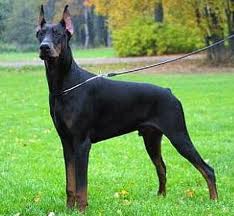
Country of Origin: The Doberman Pinscher (also known as a Dobermann or affectionately called ‘Dobe’) was bred in Germany in the late nineteenth century, almost exclusively as the work of one man—Louis Dobermann. Dobermann was a tax collector who sought to breed an alert guard dog for personal protection. Within a decade, a breed similar to the modern Doberman Pinscher had been created, popularized, and imported to America. In America, it became a popular guard and police dog, and later a well-admired show dog. By the late 1970’s, the Doberman Pinscher was the second most popular breed in America. Today, it serves mostly as a pet. Famous Doberman Pinschers include Zeus and Apollo, ‘the lads’ from ‘Magnum, P.I.’. Doberman Pinschers are the official combat dog of the U.S. Marines.
Size: The Doberman Pinscher is a medium to large sized dog with a shoulder height of 63-72 cm (25-28 in) and a weight of 27-45 kg (60-100 lbs). Some Doberman Pinschers weigh over 100 pounds, usually serving as guard dogs or police dogs. The Doberman Pinscher has a long, wedged shape head, almond-shaped eyes, a flat skull, and erect ears (which may be cropped). They have small, round feet and docked tails.
Coat: The Doberman Pinscher has a short, stiff, smooth, coat. It can be black, brown, or fawn, all with tan markings. Black and tan is most common. Markings are usually found on the muzzle, legs, feet, and chest. The Doberman Pinscher is an average shedder.
Character: Doberman Pinschers have a tendency to become very loyal and devoted to one particular person. They are brave and intelligent, making excellent guard-dogs. Doberman Pinschers are not bullies or violent by nature, but they are highly protective and can be pushy if left unchecked.
Temperament: If properly socialized, Doberman Pinschers get along well with children, other dogs, and other household pets. Doberman Pinschers should be socialized when young. They are uncomfortable with strangers and do not take kindly to unwanted visitors. Dobes require a dominant owner to ensure they do not become overly aggressive. They are honorable, fearless, and devoted, making fine companions.
Care: The Doberman Pinscher must have its claws kept short. The teeth should be brushed regularly and checked periodically for tartar. Remove dead hairs from the Doberman Pinscher’s coat with a knobbed rubber glove during shedding. Dobes are susceptible to Von Willebrand disease (a blood disorder), hip dysplasia, and obesity. They are also sensitive to cold, and should not be left to live outdoors in cold climates. The white Doberman Pinscher may be more susceptible to deafness or blindness, but this is disputed. The Doberman Pinscher has a life span of 8-12 years, and has litters of 3-8 pups.
Training: The Doberman Pinscher must be trained carefully, thoroughly, and consistently. One should never hit a Doberman Pinscher, and should avoid pressuring the dog during the early stages of training. Females may be more stubborn than males.
Activity: The speed and tremendous stamina of the Doberman Pinscher make it ideal for a variety of outdoor sports. It requires frequent exercise and will not be satisfied with daily walks around the neighborhood. The Doberman Pinscher is not suited to apartment life.
